
12 KiB
| title | chunk | source | category | tags | date_saved | instance |
|---|---|---|---|---|---|---|
| Session hijacking - Glossary | MDN | 1/3 | https://developer.mozilla.org/en-US/docs/Glossary/Session_Hijacking | reference | web, html, css, javascript, documentation | 2026-05-05T05:45:06.044734+00:00 | kb-cron |
MDN HTML HTML: Markup language
HTML reference
HTML guides
Markup languages
CSS reference
CSS guides
Layout cookbook
JavaScriptJS JavaScript: Scripting language
JS reference
JS guides
Web APIs Web APIs: Programming interfaces
Web API reference
Web API guides
- Using the Web animation API
- Using the Fetch API
- Working with the History API
- Using the Web speech API
- Using web workers
Technologies
Topics
Learn Learn web development
Frontend developer course
- Getting started modules
- Core modules
- MDN Curriculum
- Check out the video course from Scrimba, our partner
Learn HTML
Learn CSS
Learn JavaScript
Tools Discover our tools
About Get to know MDN better
Session hijacking
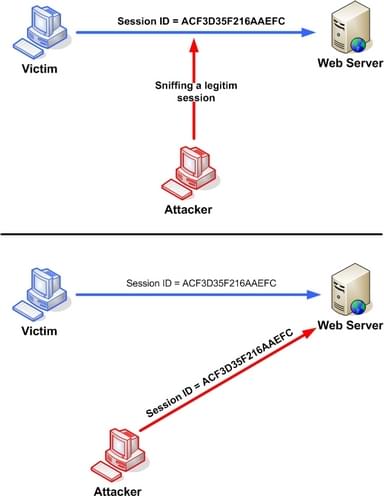
Session hijacking occurs when an attacker takes over a valid session between two computers. The attacker steals a valid session ID in order to break into the system and snoop data.
Most authentication occurs only at the start of a TCP session. In TCP session hijacking, an attacker gains access by taking over a TCP session between two machines in mid session.
In this article
- Session hijacking occurs because
- Session hijacking process
- Protection against session hijacking
- See also
Session hijacking occurs because
- no account lockout for invalid session IDs
- weak session-ID generation algorithm
- insecure handling
- indefinite session expiration time
- short session IDs
- transmission in plain text
Session hijacking process
- Sniff , that is perform a man-in-the-middle (MITM) attack, place yourself between victim and server.
- Monitor packets flowing between server and user.
- Break the victim machine's connection.
- Take control of the session.
- Inject new packets to the server using the Victim's Session ID.
Protection against session hijacking
- create a secure communication channel with SSH (secure shell)
- pass authentication cookies over HTTPS connection
- implement logout functionality so the user can end the session
- generate the session ID after successful login
- pass encrypted data between the users and the web server
- use a string or long random number as a session key
See also
- Session hijacking on Wikipedia