
11 KiB
| title | chunk | source | category | tags | date_saved | instance |
|---|---|---|---|---|---|---|
| State machine - Glossary | MDN | 1/3 | https://developer.mozilla.org/en-US/docs/Glossary/State_machine | reference | web, html, css, javascript, documentation | 2026-05-05T05:45:55.902114+00:00 | kb-cron |
MDN HTML HTML: Markup language
HTML reference
HTML guides
Markup languages
CSS reference
CSS guides
Layout cookbook
JavaScriptJS JavaScript: Scripting language
JS reference
JS guides
Web APIs Web APIs: Programming interfaces
Web API reference
Web API guides
- Using the Web animation API
- Using the Fetch API
- Working with the History API
- Using the Web speech API
- Using web workers
Technologies
Topics
Learn Learn web development
Frontend developer course
- Getting started modules
- Core modules
- MDN Curriculum
- Check out the video course from Scrimba, our partner
Learn HTML
Learn CSS
Learn JavaScript
Tools Discover our tools
About Get to know MDN better
State machine
A state machine is a mathematical abstraction used to design algorithms. A state machine reads a set of inputs and changes to a different state based on those inputs. A state is a description of the status of a system waiting to execute a transition. A transition is a set of actions to execute when a condition is fulfilled or an event received. In a state diagram, circles represent each possible state and arrows represent transitions between states. Looking at the final state, you can discern something about the series of inputs leading to that state. There are two types of basic state machines:
deterministic finite state machine
This kind allows only one possible transition for any allowed input. This is like the "if" statement in that if x then doThis else doThat is not possible. The computer must perform one of the two options.
non-deterministic finite state machine
Given some state, an input can lead to more than one different state.
Figure 1: Deterministic Finite State Machine.
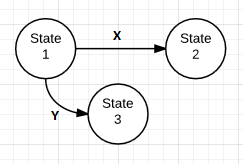 In Figure 1 , the state begins in State 1; the state changes to State 2 given input 'X', or to State 3 given input 'Y'.
Figure 2: Non-Deterministic Finite State Machine.
In Figure 1 , the state begins in State 1; the state changes to State 2 given input 'X', or to State 3 given input 'Y'.
Figure 2: Non-Deterministic Finite State Machine.
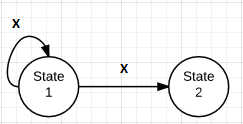 In Figure 2 , given input 'X', the state can persist or change to State 2.
Note that any regular expression can be represented by a state machine.
In Figure 2 , given input 'X', the state can persist or change to State 2.
Note that any regular expression can be represented by a state machine.
In this article
See also
- Finite-state machine on Wikipedia
- UML state machine on Wikipedia
- Moore machine on Wikipedia
- Mealy machine on Wikipedia