
12 KiB
| title | chunk | source | category | tags | date_saved | instance |
|---|---|---|---|---|---|---|
| SQL injection - Glossary | MDN | 1/3 | https://developer.mozilla.org/en-US/docs/Glossary/SQL_Injection | reference | web, html, css, javascript, documentation | 2026-05-05T05:44:01.773632+00:00 | kb-cron |
MDN HTML HTML: Markup language
HTML reference
HTML guides
Markup languages
CSS reference
CSS guides
Layout cookbook
JavaScriptJS JavaScript: Scripting language
JS reference
JS guides
Web APIs Web APIs: Programming interfaces
Web API reference
Web API guides
- Using the Web animation API
- Using the Fetch API
- Working with the History API
- Using the Web speech API
- Using web workers
Technologies
Topics
Learn Learn web development
Frontend developer course
- Getting started modules
- Core modules
- MDN Curriculum
- Check out the video course from Scrimba, our partner
Learn HTML
Learn CSS
Learn JavaScript
Tools Discover our tools
About Get to know MDN better
SQL injection
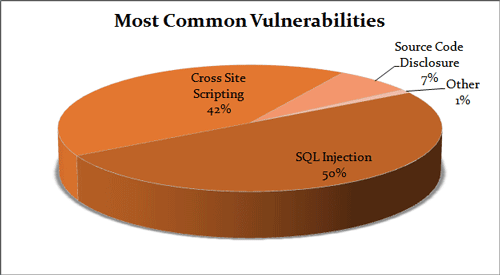
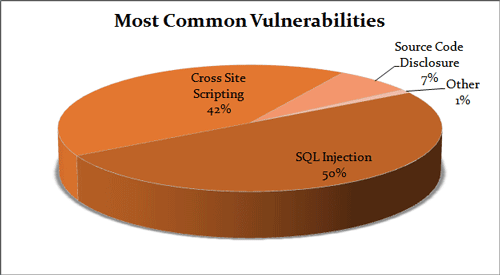
SQL injection takes advantage of Web apps that fail to validate user input. Hackers can maliciously pass SQL commands through the Web app for execution by a backend database.
SQL injection can gain unauthorized access to a database or to retrieve information directly from the database. Many data breaches are due to SQL injection.
 Original source
In this article
How It Works
 After entering username and password, behind the GUI the SQL queries work as follows:
Now suppose User enters the Username: admin and Password: passwd123, so after clicking on the Log in button, SQL query will run as follows:
If the credentials are correct, then the user is allowed to log in, so it's a very simple (and therefore insecure) mechanism. Hackers use this insecurity to gain unauthorized access.
Hackers use a simple string called a Magical String, for example:
Username:admin
Password:anything 'or'1'='1
After clicking on the login button, the SQL query will work as follows:
Just take a closer look at the above query's password section.
After entering username and password, behind the GUI the SQL queries work as follows:
Now suppose User enters the Username: admin and Password: passwd123, so after clicking on the Log in button, SQL query will run as follows:
If the credentials are correct, then the user is allowed to log in, so it's a very simple (and therefore insecure) mechanism. Hackers use this insecurity to gain unauthorized access.
Hackers use a simple string called a Magical String, for example:
Username:admin
Password:anything 'or'1'='1
After clicking on the login button, the SQL query will work as follows:
Just take a closer look at the above query's password section.
Password=' anything 'or'1'='1 '
The password is not 'anything', hence password=anything results in FALSE, but '1'='1' is a TRUE statement and hence returns a TRUE value. Finally, due to the OR operator, the value (FALSE OR TRUE) is TRUE, so authentication bypasses successfully. Just due to a simple string (Magical String) the entire database is compromised.
How To Prevent
Before executing the queries for the user credentials, make some changes like the following: So due to (1) each single quote (') in the input string is replaced with double quotes ("), and due to (2) before every (') it adds (/). The revised magical string fails to bypass the authentication, and your database stays secure.
See also
- SQL injection on Wikipedia
- Explanation of SQL injection on OWASP (Open Web Application Security Project)