
10 KiB
| title | chunk | source | category | tags | date_saved | instance |
|---|---|---|---|---|---|---|
| Bézier curve - Glossary | MDN | 1/3 | https://developer.mozilla.org/en-US/docs/Glossary/Bezier_curve | reference | web, html, css, javascript, documentation | 2026-05-05T05:25:00.448791+00:00 | kb-cron |
MDN HTML HTML: Markup language
HTML reference
HTML guides
Markup languages
CSS reference
CSS guides
Layout cookbook
JavaScriptJS JavaScript: Scripting language
JS reference
JS guides
Web APIs Web APIs: Programming interfaces
Web API reference
Web API guides
- Using the Web animation API
- Using the Fetch API
- Working with the History API
- Using the Web speech API
- Using web workers
Technologies
Topics
Learn Learn web development
Frontend developer course
- Getting started modules
- Core modules
- MDN Curriculum
- Check out the video course from Scrimba, our partner
Learn HTML
Learn CSS
Learn JavaScript
Tools Discover our tools
About Get to know MDN better
Bézier curve
A Bézier curve (pronounced [bezje]) is a mathematically described curve used in computer graphics and animation. In vector images, they are used to model smooth curves that can be scaled indefinitely.
The curve is defined by a set of control points with a minimum of two. Web related graphics and animations often use cubic Béziers, which are curves with four control points P0, P1, P2, and P3.
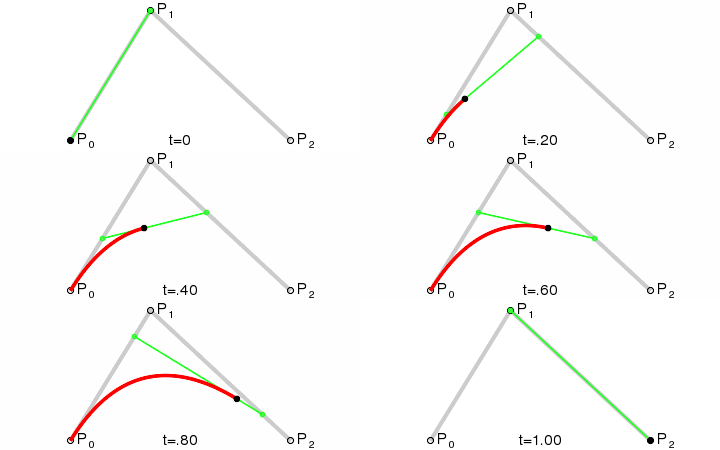
To draw a quadratic Bézier curve, two imaginary lines are drawn, one from P0 to P1 and the other from P1 to P2. A third imaginary line is drawn with its starting point moving steadily on the first helper line and the end point on the second helper line. On this imaginary line a point is drawn from its starting point moving steadily to its end point. The curve this point describes is the Bézier curve. Here's an animated illustration demonstrating the creation of the curve:
In this article
See also
- Bézier curve on Wikipedia
- Cubic Bézier easing functions in CSS
keySplinesSVG attribute